Happy holidays from The Illumenati. 'Tis the season for gift-giving, year-end audits, and that perennial compliance question: "Do you maintain a complete and accurate inventory of all assets?"
Today, we're examining asset management through the lens of history's most ambitious logistics operation: Santa's Workshop. Because if one man can track 8 billion customized deliverables with 100% accuracy and zero security incidents, surely your organization can inventory its laptops.
(Spoiler: the secret isn't magic. It's process.)
INTEL DROP: The Scale of Santa's Operation
Let's appreciate the scope of what Santa's Workshop accomplishes annually:
Meanwhile, most organizations struggle to answer basic questions like "How many laptops do we have?" and "Who owns this server that's been running since 2019?"
The difference? Santa treats asset management as a first-class operational concern, not a checkbox for auditors.
What the Frameworks Actually Require
Before we dive into Santa's methods, let's review what compliance frameworks actually demand for asset management. Spoiler: it's more than a spreadsheet.
SOC 2 (Trust Services Criteria)
CC6.1: The entity implements logical access security software, infrastructure, and architectures over protected information assets.
Translation: You can't protect what you don't know you have. SOC 2 requires you to identify and classify assets so you can apply appropriate controls. Auditors will ask for your asset inventory and check that security controls are applied consistently.
ISO 27001:2022
Annex A.5.9 – Inventory of Information and Other Associated Assets: "An inventory of information and other associated assets, including owners, shall be developed and maintained."
Annex A.5.10 – Acceptable Use of Information and Other Associated Assets: Rules for acceptable use must be identified and documented.
Annex A.5.11 – Return of Assets: Personnel shall return all assets upon termination.
ISO 27001 is explicit: you need an inventory, you need owners, and you need lifecycle management from acquisition through disposal.
NIST Cybersecurity Framework 2.0
ID.AM (Asset Management): The data, personnel, devices, systems, and facilities that enable the organization to achieve business purposes are identified and managed consistent with their relative importance to organizational objectives and risk strategy.
CIS Controls v8
Control 1 – Inventory and Control of Enterprise Assets: Actively manage all enterprise assets connected to the infrastructure physically, virtually, remotely, and those within cloud environments.
Control 2 – Inventory and Control of Software Assets: Actively manage all software on the network so that only authorized software is installed and can execute.
CIS puts asset inventory as Controls 1 and 2 for a reason: everything else depends on it.
How Santa Actually Does It
Santa's Workshop has been operating at scale for centuries. Here's what we can learn from the North Pole's asset management program:
1. Every Asset Gets a Unique Identifier at Creation
The moment a toy comes off the assembly line, it receives a unique tag linking it to its intended recipient. No asset exists without an identifier and an owner.
Your takeaway: Tag assets at procurement/creation, not retroactively. Every laptop, server, and software license should have a unique ID in your system before it's deployed.
2. Classification Is Built Into the Process
Toys are automatically classified by type, recipient age range, and delivery priority. A gaming console and a stuffed animal have different handling requirements – and the Workshop knows this from day one.
Your takeaway: Don't classify assets after the fact. Build classification into your procurement and deployment workflows. When a new laptop is ordered, capture: Is it for an executive? Does it handle sensitive data? What compliance scope does it fall under?
3. Ownership Is Non-Negotiable
Every present has exactly one recipient. There's no ambiguity about who "owns" each asset. The Naughty/Nice database serves as the authoritative source of asset-to-owner mapping.
Your takeaway: Every asset needs an owner – a real person accountable for it, not "IT Department." When that person leaves, ownership must transfer. No orphaned assets.
4. Real-Time Visibility, Not Annual Audits
Santa doesn't do a yearly inventory count and hope for the best. The Workshop maintains real-time visibility into every asset's status and location. When something changes, the system knows immediately.
Your takeaway: Static spreadsheets updated quarterly are not asset management. You need automated discovery and continuous reconciliation between what you think you have and what's actually on your network.
5. Lifecycle Management Is Automatic
Once a present is delivered, it's marked as "deployed" and removed from the Workshop's active inventory. There's a clear handoff process. No assets linger in limbo.
Your takeaway: Define clear lifecycle stages (Ordered → Received → Deployed → Retired → Disposed) and track transitions. When an employee returns a laptop, it shouldn't sit in a closet for two years still assigned to them in your CMDB.
Building Your Own Asset Workshop
Here's how to build an asset management program that would make Santa proud (and satisfy your auditors):
Step 1: Define What Counts as an "Asset"
Asset management scope varies by framework and organization. At minimum, you typically need to track:
Step 2: Establish Your Source of Truth
Pick one system to be authoritative. This could be:
The key: one source of truth, not five spreadsheets owned by different teams.
Step 3: Automate Discovery
Manual inventory is a losing battle. Implement automated discovery to continuously find assets on your network and in your cloud environments. Reconcile discovered assets against your inventory to find:
Step 4: Define Required Attributes
Every asset record should capture (at minimum):
Step 5: Integrate with Lifecycle Events
Your asset inventory should automatically update when things change:
Tools of the Trade
Santa has magic. You have software. And when it comes to asset management for compliance, our top recommendation for SMBs is Snipe-IT – a free, open-source IT asset management platform that checks all the boxes auditors care about.
Spotlight: Snipe-IT for Compliance
Snipe-IT is a web-based asset management system built on Laravel that's been battle-tested by thousands of organizations – from IT departments to (we kid you not) oil rigs and theater companies. It's free, open-source, and gives you everything you need to satisfy auditor requirements.
Why Snipe-IT for Compliance?
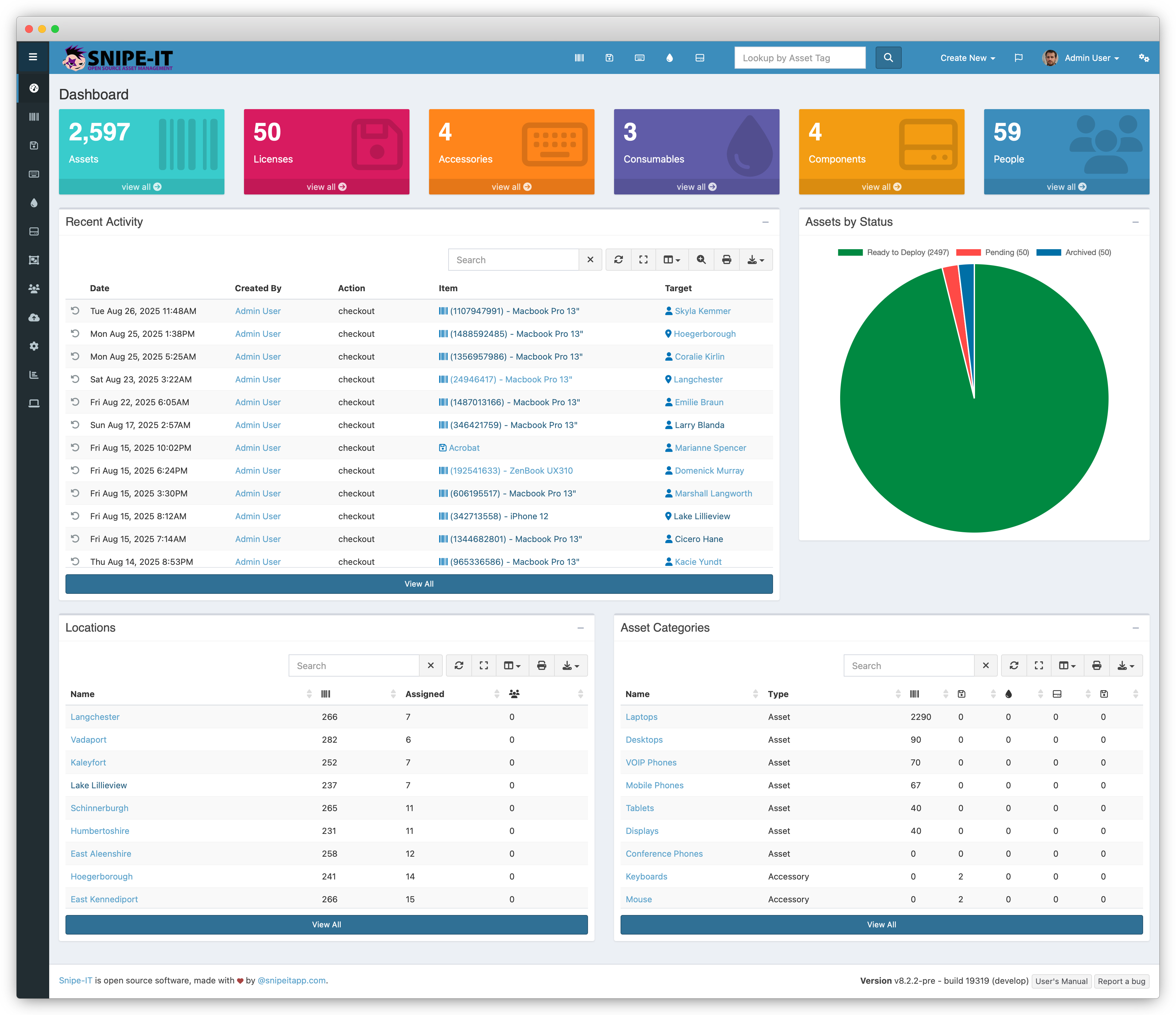
What You Can Track
Getting Started with Snipe-IT
You can self-host Snipe-IT on any LAMP stack, or use their hosted version if you don't want to manage infrastructure. Either way, you'll have a production-ready asset inventory in hours, not months.
Other Tools Worth Knowing
Snipe-IT is our top pick for physical asset management, but depending on your environment, you might also need:
Pro Tip: Start With What You Have
Before buying new tools, check what you're already paying for. Your MDM (Jamf, Intune, Kandji) already tracks endpoints. Your cloud provider has resource inventories built in. Start there, then use Snipe-IT to consolidate everything into one auditable source of truth.
The Bottom Line
Santa's asset management success isn't magic – it's discipline. Every present (asset) is tracked from creation to delivery, with clear ownership, classification, and lifecycle management throughout.
Your organization might not be delivering 8 billion items annually, but the principles are identical:
Get this right, and every other security control becomes easier. Access reviews? You know what systems to review. Vulnerability management? You know what to scan. Incident response? You know what was affected.
Asset management is the gift that keeps on giving.
Happy holidays from all of us at Illumen. May your assets be inventoried, your owners be assigned, and your spreadsheets be retired.
And if your asset management program needs a little holiday magic (or a lot of professional help), you know where to find us.