> initializing ai_governance_assessment...
> scanning_current_frameworks: SOC_2, ISO_27001
> ai_risk_coverage: INSUFFICIENT
> model_drift_monitoring: NOT_FOUND
> bias_mitigation_controls: NOT_FOUND
> eu_ai_act_high_risk_obligations: DEC_2027 [DELAYED]
> recommendation: IMPLEMENT_ISO_42001
> status: CRITICAL_GAP_IDENTIFIED
Your organization just deployed its fifth AI model this quarter. The chatbot handles customer inquiries. The recommendation engine drives 40% of sales. The fraud detection system processes millions of transactions daily. Your SOC 2 Type II report is pristine. Your ISO 27001 certification is current.
And you have a massive compliance gap.
Here's the uncomfortable truth: SOC 2 and ISO 27001 were designed for a different era of technology. They're excellent at verifying controls for data storage, access management, and traditional software development. But they lack the specific criteria to address the unique risks posed by AI and machine learning systems—model drift, algorithmic bias, training data governance, and the explainability problem.
Enter ISO 42001—the world's first international standard specifically designed for AI management systems. Published in December 2023, it's rapidly becoming the benchmark for responsible AI governance. And with EU AI Act obligations phasing in—even after the high-risk deadline moved to December 2027—it's no longer optional.
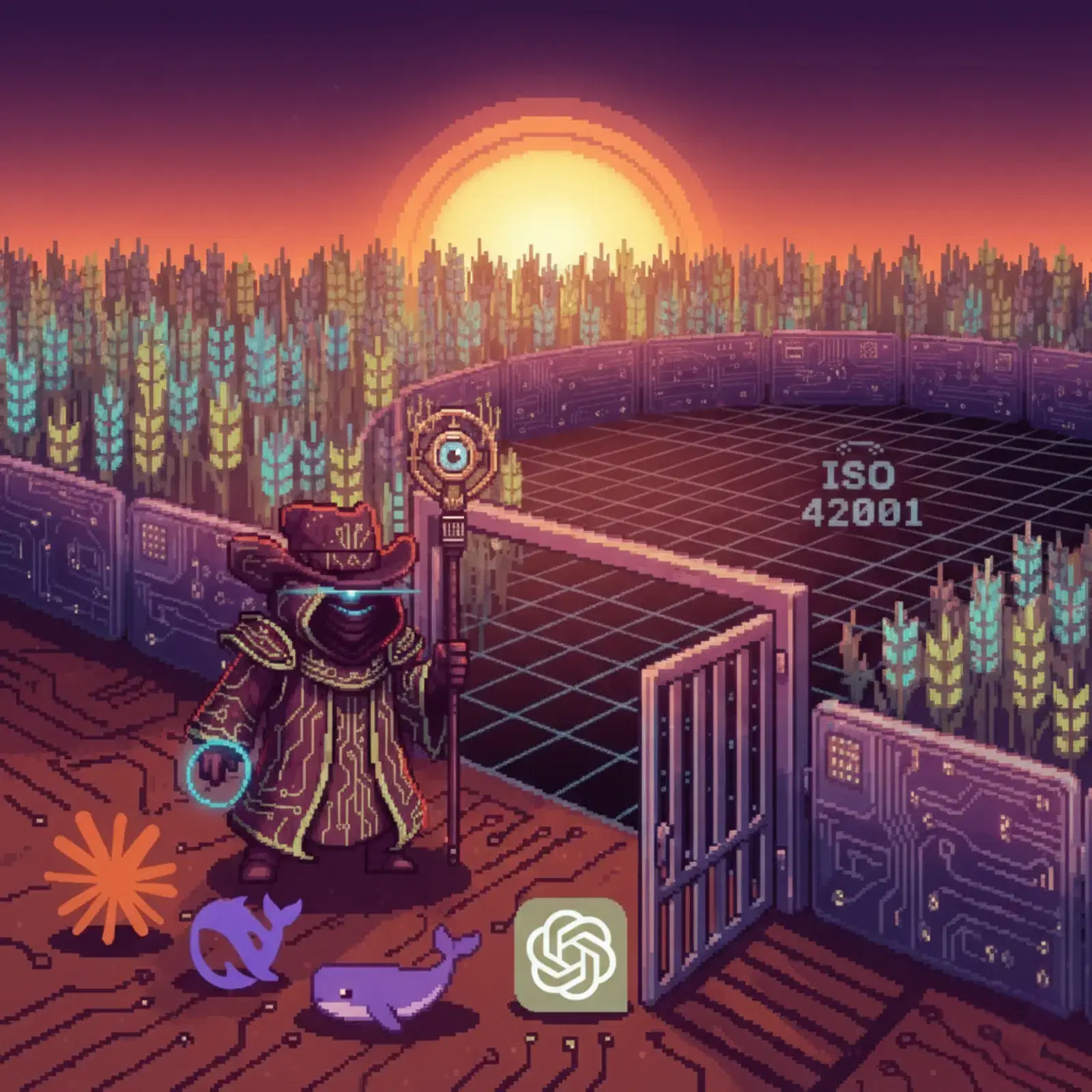
getting all these AI models in line... HEEYAH! 🤠
INTEL DROP: AI Governance News
> scanning_ai_governance_landscape...
> eu_ai_act_phase_2: ACTIVE [FEB 2026]
> iso_42001_adoption: ACCELERATING
> aigp_certification_signups: 4000+ FIRST_MONTH
> high_risk_obligations: DEC_2027 [DELAYED FROM AUG_2026]
> status: REGULATORY_STORM_INCOMING
The AI governance landscape is moving faster than most organizations realize. Here's what's making headlines:
→EU AI Act high-risk timeline [UPDATED JUNE 2026]: When this issue first ran, full high-risk obligations—conformity assessments, CE marking, comprehensive transparency requirements—were slated for August 2026. The May 2026 trilogue agreement has since pushed standalone high-risk obligations to December 2, 2027 (embedded systems to August 2, 2028); prohibited-practice and GPAI rules remain in force. Full breakdown in Issue #019. (EU AI Act) →Commission enforcement powers follow the delayed timeline: The EU Commission gains power to conduct investigations, issue orders, and levy fines as high-risk obligations land—now December 2027 for standalone systems and August 2028 for embedded systems under the Digital Omnibus agreement. (ISMS.online) →ISO 42001 + EU AI Act: The practical pairing: ISACA reports that ISO/IEC 42001 operationalizes EU AI Act requirements through its plan-do-check-act structure. The EU AI Act defines what must be achieved; ISO 42001 describes how to run, evidence, and continuously improve an AI governance program. (ISACA) →AI governance becomes C-suite priority: IAPP's AIGP (AI Governance Professional) certification attracted 4,000+ signups in its first month, signaling massive demand for governance expertise. The skills gap is real. (Glacis AI Governance Guide) →ISO 27001 organizations can fast-track: Organizations with existing ISO 27001 certification can achieve ISO 42001 compliance up to 40% faster than those starting from scratch, thanks to shared management system structure and overlapping controls. (Protecht Group) The regulatory pressure is real. And it's not just the EU—enterprise customers globally are starting to ask pointed questions about AI governance that your SOC 2 report can't answer.
security teams discovering their AI governance gap
WHAT IS ISO 42001?
ISO/IEC 42001:2023 is the world's first international standard for Artificial Intelligence Management Systems (AIMS). Published in December 2023, it provides a structured framework for organizations to manage the risks and opportunities associated with AI responsibly.
Think of it as ISO 27001's cousin, but purpose-built for AI. It follows the same Plan-Do-Check-Act methodology, uses a similar management system structure, and is designed to integrate seamlessly with existing ISO certifications.
Core Philosophy
ISO 42001 takes a lifecycle approach to AI governance. It addresses concerns from initial concept through deployment and operation:
█Responsible development: How AI systems are designed, trained, and validated
█Ethical considerations: Fairness, transparency, and human oversight
█Risk management: Identifying and mitigating AI-specific risks
█Continuous improvement: Ongoing monitoring and adaptation
Who Needs It?
ISO 42001 applies to any organization that develops, provides, or uses AI systems:
→AI product companies: Building and selling AI-powered solutions
→AI service providers: Offering AI as a service (model hosting, API access)
→Enterprise adopters: Deploying AI for internal operations or customer-facing applications
→AI supply chain: Providing training data, model components, or infrastructure
If you're using ChatGPT, GitHub Copilot, or any LLM in your workflows—yes, you should be thinking about this.
WHY TRADITIONAL FRAMEWORKS FALL SHORT
your SOC 2 report when asked about AI model governance
Let's be clear: SOC 2 and ISO 27001 remain foundational. They cover critical ground—access controls, encryption, incident response, vendor management. You need them. But they weren't designed to address AI-specific risks.
What Traditional Frameworks Cover Well
✓Data storage and encryption
✓Access control and authentication
✓Change management for traditional software
✓Incident response procedures
✓Vendor and third-party risk
What They Miss for AI Systems
✗Model drift monitoring: AI models degrade over time as data patterns change. Traditional frameworks don't address continuous model validation.
✗Algorithmic bias: No controls for detecting, measuring, or mitigating bias in model outputs across protected classes.
✗Training data governance: Where did the data come from? Is it representative? Are there consent issues? Traditional frameworks don't ask.
✗Explainability: Can you explain why the model made a specific decision? Regulators are starting to require this.
✗AI-specific incident response: What happens when your model makes a high-profile wrong decision? The playbook is different.
> mapping traditional_controls to ai_risks...
>
> SOC_2_CC6.1 (access_control) → model_retraining_access: PARTIAL
> SOC_2_CC7.2 (monitoring) → model_drift_detection: NOT_COVERED
> ISO_27001_A.12.1.4 (change_mgmt) → continuous_learning: NOT_COVERED
> ISO_27001_A.18.1.4 (privacy) → training_data_consent: PARTIAL
>
> coverage_assessment: 35% of AI risks addressed
> recommendation: SUPPLEMENTAL_FRAMEWORK_REQUIRED
KEY REQUIREMENTS AND CONTROLS
ISO 42001 follows the familiar high-level structure (HLS) of other ISO management system standards, with Clauses 4-10 covering organizational requirements and Annex A providing specific controls.
Management System Clauses (4-10)
[4]Context of the Organization: Understanding stakeholder needs and defining AIMS scope for AI systems
[5]Leadership: Top management commitment to AI policy, roles, and responsibilities
[6]Planning: AI risk assessment, impact assessment, and treatment planning
[7]Support: Resources, competence, awareness, and documentation for AI governance
[8]Operation: AI system lifecycle management, from development through deployment
[9]Performance Evaluation: Monitoring, measurement, analysis, and internal audit of AI systems
[10]Improvement: Nonconformity handling, corrective action, and continual improvement
Annex A: AI-Specific Controls
This is where ISO 42001 gets specific. Annex A controls address the unique risks of AI systems:
█Data governance: Training data quality, provenance, consent, and representativeness
█Bias and fairness: Detection, measurement, and mitigation of algorithmic bias
█Transparency: Explainability of AI decisions, disclosure requirements
█Human oversight: Human-in-the-loop controls, override capabilities
█Model lifecycle: Version control, testing, validation, and retirement
█Third-party AI: Due diligence for AI components from external providers
> sample_iso_42001_control_mapping...
>
> RISK: algorithmic_bias_in_hiring_model
> CONTROL: A.5.4 - Fairness assessment procedures
> EVIDENCE: bias_audit_report_q4_2025.pdf
> FREQUENCY: quarterly
> OWNER: ml_governance_team
>
> RISK: training_data_contamination
> CONTROL: A.6.2 - Data quality management
> EVIDENCE: data_lineage_documentation.md
> FREQUENCY: per_training_run
> OWNER: data_engineering
GETTING STARTED WITH AI GOVERNANCE
You don't need to boil the ocean. Here's a practical roadmap for building AI governance capabilities:
Phase 1: Inventory and Assess (Weeks 1-4)
[1]AI system inventory: Catalog all AI and ML systems in use—including third-party APIs, embedded AI features, and shadow AI
[2]Risk classification: Categorize systems by risk level (consider EU AI Act categories as a starting point)
[3]Gap assessment: Map current controls against ISO 42001 requirements to identify gaps
[4]Stakeholder mapping: Identify who owns AI governance across the organization
Phase 2: Foundation (Weeks 5-12)
[1]AI policy: Establish organizational AI principles and acceptable use guidelines
[2]Governance structure: Define roles, responsibilities, and decision-making authority for AI
[3]Risk methodology: Develop AI-specific risk assessment procedures
[4]Priority controls: Implement highest-priority Annex A controls for your highest-risk systems
Phase 3: Operationalize (Weeks 13-24)
[1]Remaining controls: Implement full Annex A control set based on risk priorities
[2]Monitoring: Establish model performance monitoring and drift detection
[3]Documentation: Complete technical documentation and evidence collection
[4]Training: Build organizational competence in AI governance
TECH RITUALS: VerifyWise—Open Source AI Governance
Want to get started with AI governance without spending a fortune on GRC platforms? Meet VerifyWise—an open source AI governance platform that supports EU AI Act, ISO 42001, ISO 27001, and NIST AI RMF compliance.
What VerifyWise Does
VerifyWise provides a centralized platform for managing AI compliance across your organization:
✓AI Model Inventory: Centralized catalog of all AI systems with risk classifications
✓Risk Management: Purpose-built risk scoring for AI—covering bias, model failure, data poisoning, and more
✓Framework Mapping: Pre-built mappings to EU AI Act, ISO 42001, ISO 27001, and NIST AI RMF controls
✓Audit Trails: Comprehensive evidence collection and audit trail documentation
✓Cloud Integration: Connects with AWS, Azure, and Google Cloud Platform
✓On-Prem Option: Self-host when data residency requirements demand it
Getting Started with VerifyWise
# INSTALL VERIFYWISE
> git clone https://github.com/bluewave-labs/verifywise.git
> cd verifywise
> docker-compose up -d
# Access the dashboard at http://localhost:3000
# Documentation: https://github.com/bluewave-labs/verifywise-docs
The platform is fully open source under an MIT-style license, so you can inspect the code, contribute improvements, or fork it for your specific needs. Enterprise support is available if you need production SLAs.
Why We Recommend It
We've evaluated several AI governance platforms, and VerifyWise stands out for a few reasons:
[1]Framework coverage: Pre-built support for the frameworks that matter (EU AI Act, ISO 42001) saves significant mapping work
[2]Open source transparency: You can see exactly what the tool does—critical for compliance tooling
[3]Active development: Regular updates tracking evolving regulatory requirements
[4]Zero cost to start: Get your AI governance program running before committing budget
Links:
THE BOTTOM LINE
> compiling_insights...
> iso_42001_status: ESSENTIAL_NOT_OPTIONAL
> eu_ai_act_enforcement: PHASED [HIGH_RISK: DEC_2027]
> traditional_frameworks: NECESSARY_BUT_INSUFFICIENT
> free_tooling_available: YES
> recommendation: START_NOW
AI governance isn't a future concern—it's a present requirement. The EU AI Act is already in phased enforcement, and the delayed high-risk deadline (December 2027) is runway, not a reprieve. Enterprise customers are already asking questions. And the risks of ungoverned AI—from regulatory fines to reputational damage to actual harm—are real.
ISO 42001 provides the framework your organization needs. It doesn't replace SOC 2 or ISO 27001—it complements them, filling the AI-shaped hole in your compliance posture. And with tools like VerifyWise available for free, you can start building your AI governance program today without waiting for budget approval.
The question isn't whether you need AI governance. It's whether you'll build it proactively or reactively.
your AI systems when you finally give them proper governance
> transmission_complete
> series: AI_GOVERNANCE
> next_issue: NIST_AI_RMF_DEEP_DIVE
>
> stay_enlightened
> govern_your_ai
The Illumenati // Boutique GRC for the AI-First Era // illumen.io
Ready to close the AI governance gap? Whether you're starting from scratch or building on existing ISO 27001 certification, we can help you navigate ISO 42001 implementation and EU AI Act compliance.