
At 3:47 AM Brussels time on May 7, 2026, Council and Parliament negotiators emerged from a trilogue with a provisional agreement that does what most US compliance teams had quietly stopped believing was possible: it pushes the EU AI Act's high-risk obligations from August 2, 2026 to December 2, 2027. Embedded high-risk AI systems get even longer — until August 2, 2028.
If you have been sprinting toward an August conformity assessment, you can stop sprinting. You should not stop running. The delay is real, but the rest of the AI Act is not on pause, and the readiness data tells a story that no calendar shift can fix.
This is the breakdown that matters: what actually moved, what is still in force, and what 16 extra months should — and absolutely should not — do to your AI compliance program.
WHAT JUST HAPPENED
The trigger was the European Commission's Digital Omnibus on AI, published November 19, 2025. The Commission acknowledged what every AI compliance consultant had been warning about for months: harmonized standards were not finished, national competent authorities were still being appointed in most Member States, and the EU AI Office did not yet have the operational scaffolding to evaluate conformity assessments at the volume August 2026 would require.
Without a delay, the original deadline would have triggered a compliance scramble against rules that, in some cases, had not yet been finalized. The Commission proposed deferral. Six months of inter-institutional negotiation followed. The May 7 trilogue settled it.
This Is Provisional, Not Final
The May 7 deal still requires formal endorsement by the Council and Parliament, followed by legal-linguistic revision before the act is officially amended. The political agreement is essentially locked, but the dates are not legally binding until adoption is complete — expected in the coming weeks. Until then, the original Article 113 timeline remains technically in force.
For practical purposes, treat the new dates as real. Member States will not enforce obligations everyone knows are about to be amended, and Commission guidance is already being drafted around the new timeline. But do not throw away your August 2026 conformity assessment work. It still applies — just on a different schedule.
THE NEW TIMELINE
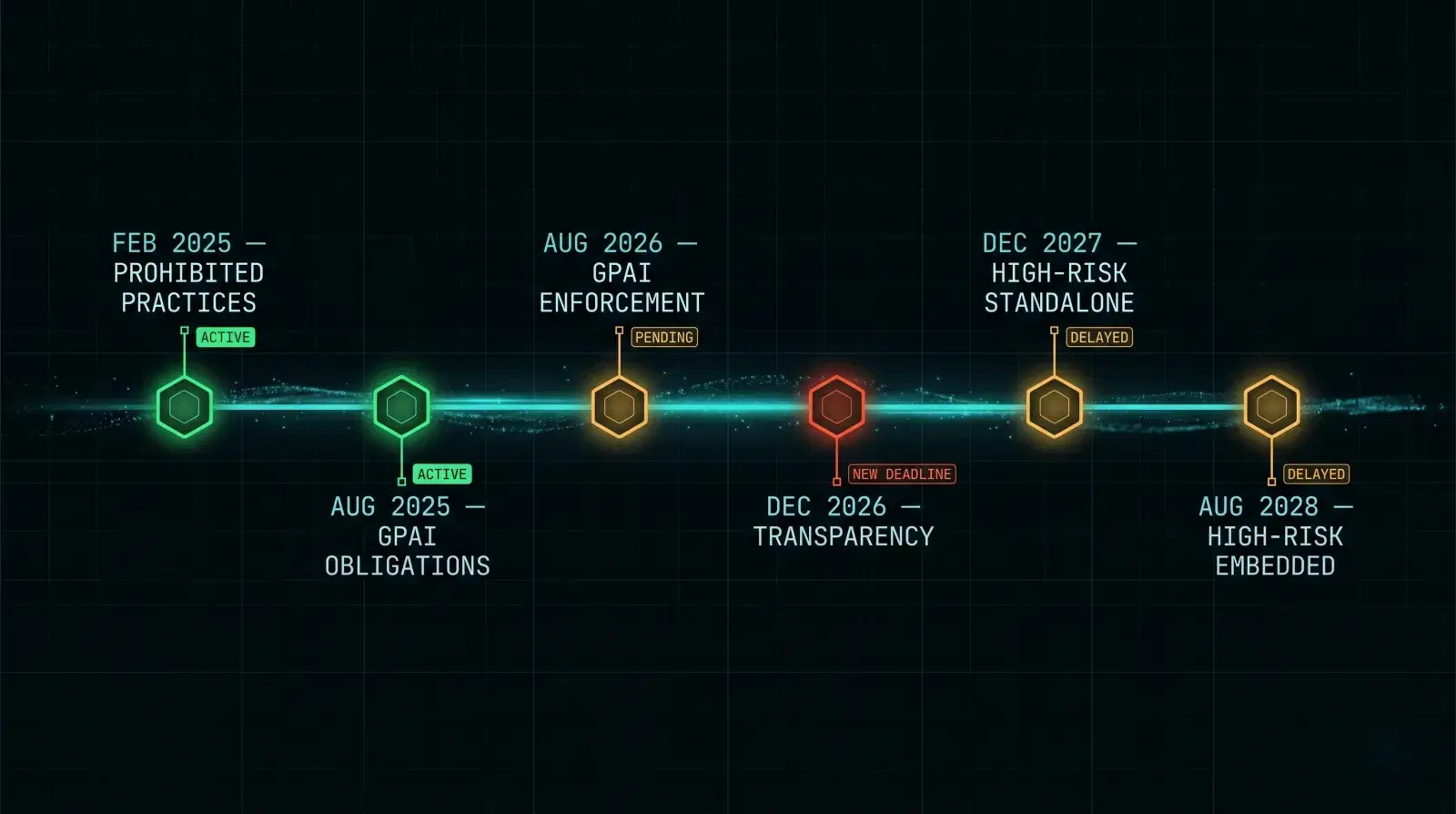
The mistake most US compliance teams made in 2025 was treating August 2, 2026 as a singular deadline. The AI Act was always a phased rollout. The May 7 deal makes that phasing more spread out — and slightly more confusing. Here is the full revised map.
The delay only touched two of those rows. Everything else either is already binding or moves forward on its original or accelerated schedule. If your compliance roadmap was a single line item that said "EU AI Act — Q3 2026," it needs to become a calendar.
And note the surprise inside the delay: the transparency obligation grace period was reduced from six months to three. Providers of generative AI systems must implement detection-friendly marking of AI-generated content (watermarking, metadata, or equivalent) by December 2, 2026 — three months sooner than the previously expected default. The headline was a delay, but for any GenAI provider, the practical effect is a tighter deadline on something you may not have engineered yet.
August 2026 did not disappear. It got replaced by a messier four-year staircase, with one rule that actually got tighter, not looser.
WHAT DIDN'T MOVE: THE 2026 OBLIGATIONS THAT STILL MATTER
The press has called this a "rollback" of the AI Act. It is not. It is a surgical delay of two compliance categories. The rest of the regime is fully alive, and several pieces of it bite in 2026.
1. Prohibited Practices (Article 5) — Already Live
Since February 2, 2025, the AI Act's outright bans have been in force. Social scoring by public authorities, real-time remote biometric identification in public spaces (with narrow law-enforcement exceptions), emotion recognition in workplaces and schools, and untargeted scraping of facial images — all illegal in the EU today. The May 7 deal added two more: AI-generated non-consensual sexual content and AI-generated child sexual abuse material.
Penalty for prohibited-practice violations: up to €35 million or 7% of worldwide annual turnover, whichever is higher. This is the largest tier of fines in the entire act.
2. AI Literacy (Article 4) — Already Live
As of February 2025, providers and deployers of AI systems must take measures to ensure their staff have a sufficient level of AI literacy. There is no certification requirement, but the obligation is enforceable, and Member State authorities are beginning to ask for evidence. If you have not run AI training for the teams that build, deploy, or supervise your AI systems, you have a documentation gap that pre-dates the May 7 deal.
3. General-Purpose AI (GPAI) Obligations — Already Live
Since August 2, 2025, providers of GPAI models have had to maintain technical documentation, publish summaries of training data, comply with EU copyright law, and share information with regulators and downstream deployers. Models with "systemic risk" (broadly, those trained at >1025 FLOPs) face additional model evaluation, incident reporting, and cybersecurity obligations.
Commission enforcement powers for GPAI obligations apply from August 2, 2026 — that date did not change. If you are deploying frontier or near-frontier models in EU markets, August is still your date.
4. AI-Generated Content Transparency — New December 2026 Date
The grace period for transparency obligations was reduced, not extended. By December 2, 2026, providers of GenAI systems must mark synthetic audio, image, video, or text outputs in a machine-readable format. Deployers of deepfakes must label them as artificially generated.
5. Penalty Architecture — Unchanged
EU AI Act Penalty Tiers (Article 99) — Unchanged by the May 7 Deal
Whichever is higher. SMEs get the lower of percentage or absolute. The fine schedule did not move — only the activation date for Tier 2 violations tied to high-risk obligations slid with the rest of those rules.
THE READINESS GAP THE DELAY DIDN'T FIX
Here is the uncomfortable subtext of the May 7 deal: regulators delayed the rules partly because they were not ready — harmonized standards, notified bodies, national authorities. But organizations were not ready either, and 16 more months will not change that without a deliberate program.
Where Companies Actually Are on AI Governance
Read those numbers carefully. They are not telling you that two-thirds of companies need a few more months. They are telling you that the operational substrate of AI governance — policies, inventories, risk registers, model documentation, deployer agreements — barely exists across the mid-market.
Even more pointedly: a 2026 industry survey of organizations that experienced an AI-related security incident found that 63% had no AI governance policy in place or were still developing one. The breach is the policy gap. The delay does not move the breach risk.
If 78% of executives cannot pass an independent AI governance audit in 90 days today, the question is not whether they will be ready in December 2027. It is whether their organizations will recognize a sample audit when it lands in their inbox in 2027.
The honest read: the delay was a gift to regulators and to a small number of well-prepared providers. For everyone else, it just postponed the moment of reckoning. Most organizations will use the extra 16 months the same way they used the previous 24 — not at all — and arrive at December 2027 in the same state they would have arrived at August 2026.
YOUR 16-MONTH WINDOW: WHAT TO ACTUALLY DO
The compliance teams that came out ahead of the May 7 deal are the ones that already had work in flight. They are not stopping that work. They are repacing it. Here is what a credible 16-month plan looks like.
Q3 2026 — Inventory and Classification (the 90-day floor)
Q4 2026 — Hit the December 2 Transparency Deadline
2027 — Build the Management System Properly
The companies that were ready for August 2026 are the companies that will be ready for December 2027. The delay does not change who wins. It changes how comfortable they are.
THE COMPLIANCE TRAP: WHY "WE'LL DO IT IN 2027" IS THE WRONG MOVE
Three predictable mistakes will show up in board decks over the next month. We have already seen all three in client conversations this week.
Mistake 1: "Pause the AI program."
Some leaders will read "delay" as "we can stop spending." This ignores prohibited practices, AI literacy, GPAI deployer obligations, the December 2026 transparency deadline, and most importantly the simple fact that AI governance is now table stakes for enterprise procurement. Your customers' security questionnaires are not waiting for August 2028.
Mistake 2: "Wait for the standards to be finalized."
The harmonized standards under CEN-CENELEC JTC 21 will keep iterating through 2027. Waiting for finality means starting late. The mature organizations are building to ISO/IEC 42001, ISO/IEC 23894, and the latest published drafts of the harmonized standards — then layering in the deltas as the official versions land. You are not designing a one-shot artifact. You are running a living management system.
Mistake 3: "US-only operations are exempt."
The AI Act applies to providers and deployers placing AI systems on the EU market — regardless of where the company is headquartered. If your B2B SaaS product is sold to a single Frankfurt-based customer who uses it to make decisions about European data subjects, you are in scope. Most US compliance teams have not yet drawn the boundary correctly, and the delay does not change extra-territorial reach.
What You Are Actually Buying With 16 Extra Months
SIGNAL VS. NOISE: WHAT'S STILL UNCERTAIN
Three open questions matter for your 2027 plan. Track them through the formal adoption phase.
The other variable to watch is enforcement appetite. Article 99 fines are administered by Member States, not by the Commission. National data protection authorities — many of which have been designated as competent authorities — have shown a pattern of moving aggressively after multi-year compliance windows close. December 2, 2027 will be that moment for high-risk AI. The early enforcement actions will set tone for years.
For practical compliance planning, treat the May 7 dates as locked, build your program to ISO/IEC 42001 with explicit AI Act mapping, and assume that "the regulators gave us more time" is a story your competitors will tell themselves while you quietly compound your readiness advantage.
The Illumenati // Boutique GRC for the AI-First Era // illumen.io
> SOURCES
- [01]Artificial Intelligence: Council and Parliament agree to simplify and streamline rules— Council of the EU
- [02]EU legislators agree to delay for high-risk AI rules— Hogan Lovells
- [03]The Digital AI Omnibus: Proposed deferral of high risk AI obligations under the AI Act— DLA Piper
- [04]EU AI Act delay: New high-risk AI deadlines provisionally agreed— The DPO Centre
- [05]Article 99: Penalties— EU Artificial Intelligence Act
- [06]Annex III: High-Risk AI Systems Referred to in Article 6(2)— EU Artificial Intelligence Act
- [07]General-purpose AI Obligations Under the EU AI Act Kick in From 2 August 2025— Baker McKenzie
- [08]EU AI Act 2026 Updates: Compliance Requirements and Business Risks— Legal Nodes
- [09]2026 AI Impact Survey Report— Grant Thornton
- [10]AI Governance & Compliance Statistics 2026— Prefactor
- [11]What the EU AI Act Enforcement Delay Actually Means for Your Organization— A-LIGN
- [12]Implementation Timeline for the EU AI Act— EU Artificial Intelligence Act